FIGMA WEAVE · NEW YORK · APPLICATION
Strategy is the prompt.
Someone has to run the graph.
Warren Velazquez. Thirteen years turning ambiguous strategy into programs that ship, and, over the last year of nights and weekends, three software tools and a nineteen-agent operating system built on his own time, to find out how much one operator can carry when the mechanisms are right. Currently UX Program Manager for Brand at Dow Jones. Earlier, two years embedded inside Google, and a decade of agency programs before those. This page is built the way Weave works: every output feeds the next.
Ten lines from the posting. Seven receipts and three partials.
A self-scored ten out of ten would be worth nothing, so this is scored the way he would score someone else. The posting runs three layers in parallel. Pick one and the graph below dims every node that does not prove it. Click any row to jump to its proof.
No filter. All thirteen nodes are live.
| # | The posting asks for | On record | |
|---|---|---|---|
| 01 | Lead cross-functional programs end to end, from problem framing through rollout and measurement | Two programs at Google in two years: the Android web properties through the Android 12 launch on a public date, and a year-long research and design phase on the future of Google Search Ads with no date and no spec. | match 05 → |
| 02 | Own the operating cadence: planning rhythm, executive rituals, review mechanisms | Owns the brand marketing team's Asana implementation at Dow Jones for reporting, capacity and resource management, across about 8 events and 5 launches in 5 months. Team and function scope, not company scope. | partial 07 → |
| 03 | Design and ship AI-powered automations that remove repetitive manual work, and roll them out | Built Relay, the intake triage the brand team at Dow Jones uses. Built Vizor on his own time, and it is in real production use today, by him and by a few agencies run by friends. | match 03 → |
| 04 | Build dashboards and inspection mechanisms that turn data into decisions, including the underlying tooling | Built a command center over 19 agents in four squads, each on its own schedule with cost tracked per agent, plus a live compliance tracker triaged by risk and by product. He specified and directed all of it himself, without an engineer and without a budget. | match 02 → |
| 05 | Develop business cases: structure ambiguous problems, research, weigh options, recommend | A 3-month research and strategy phase preceding an 8-month design phase at APS. Built the creative operations function at Everyrealm from zero and hired across four disciplines into it. Program cases, not P&L cases. | partial 08 → |
| 06 | Translate strategy into programs with clear owners, milestones, dependencies and success metrics | A design system unifying 8 Dow Jones properties into one. 6 of 8 migrated. Build time cut by about 80 percent. Cross-property design inconsistencies eliminated. | match 07 → |
| 07 | Craft executive-level narratives that synthesize insight, frame decisions and build alignment | A GE Healthcare study of 2,000 hospital-based clinicians, 5,500 patients and 24 qualitative interviews became one story, carried by his production plan through executive leadership presentations, a global website, long-form PDFs and hundreds of assets. | match 06 → |
| 08 | Partner across product, marketing, customer experience and operations | At Dow Jones he partners with the commerce and acquisition product design teams on acquisition, onboarding and upsell flows, and operates day to day across marketing, subscription strategy, commerce, product design and event marketing. | match 07 → |
| 09 | Daily hands-on AI use, with automations you have actually shipped | Three tools he specified, directed and shipped solo in roughly a year of nights and weekends, two of them in real production use. Not hand-coded: directed, reviewed and corrected. 94 development phases on PACTO alone, sequenced rather than generated in one pass. | match 04 → |
| 10 | Technical and analytical fluency: SQL and modern data tooling, Looker, Mode, Hex | Partial, and stated as such. He is not an engineer. He specifies data models, directs AI agents to build against them, and can read and correct what comes back. He has not worked inside a company's warehouse in Looker, Mode or Hex. Written out in full at node 10, not buried. | partial 10 → |
Nineteen agents in four squads. One person built all of them.
The posting asks for AI-powered automations that raise the operational ceiling without growing headcount. Warren built one to find out how far that idea actually goes, on his own time, with his own project work as the test case. Nobody commissioned it and nothing depends on it commercially. It exists because he wanted to know the answer, and it is the most complete thing he can show you about how he takes a problem apart.
These are the real names, in the order the system lists them, and every one of them appears in the screenshot below. Each agent runs on its own schedule. Hand-offs between them are traced. Cost is tracked per agent, which is the part that matters: the work has a unit price, not just an output, so the question of whether an automation is worth keeping has an answer rather than an opinion.
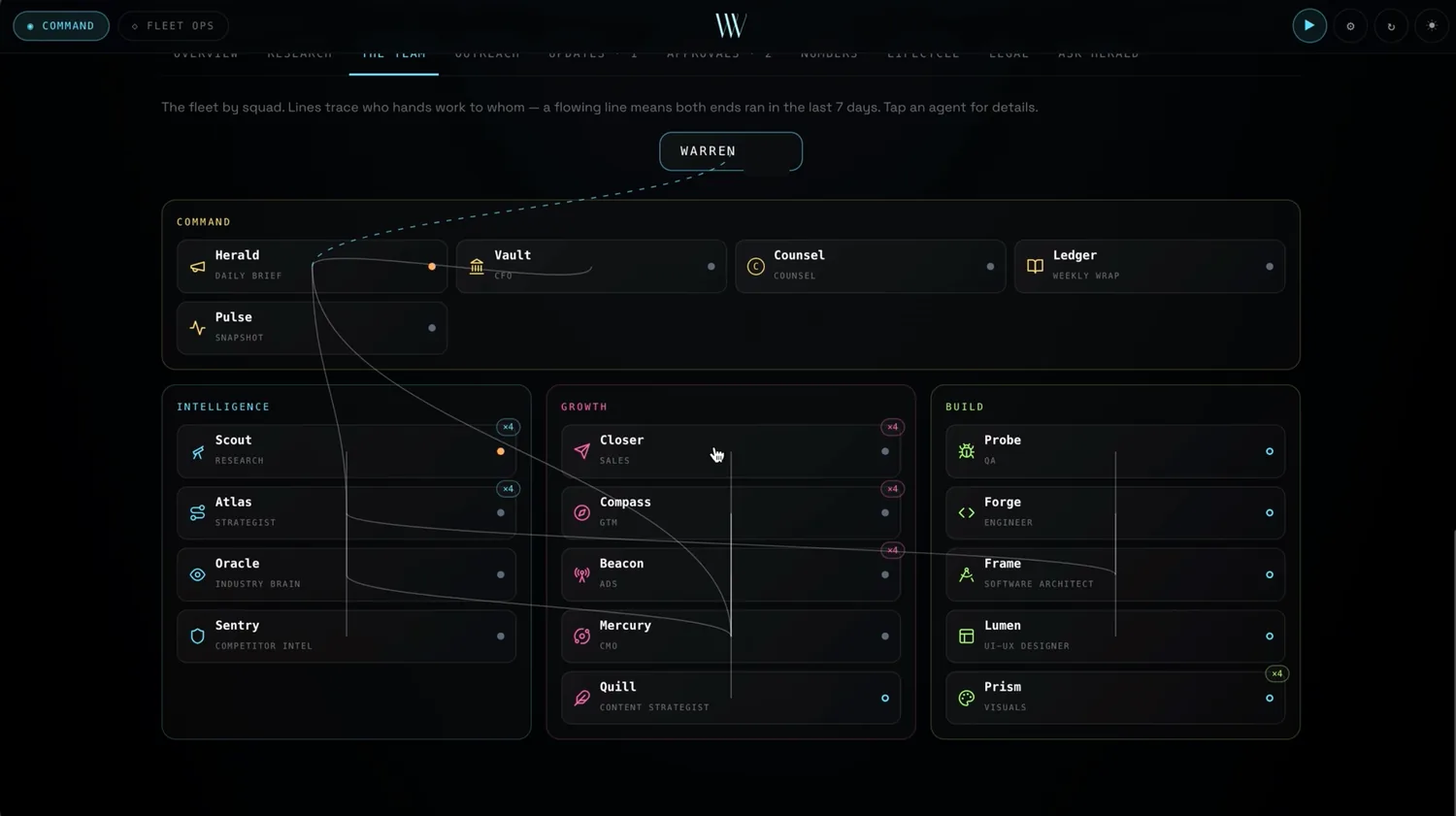
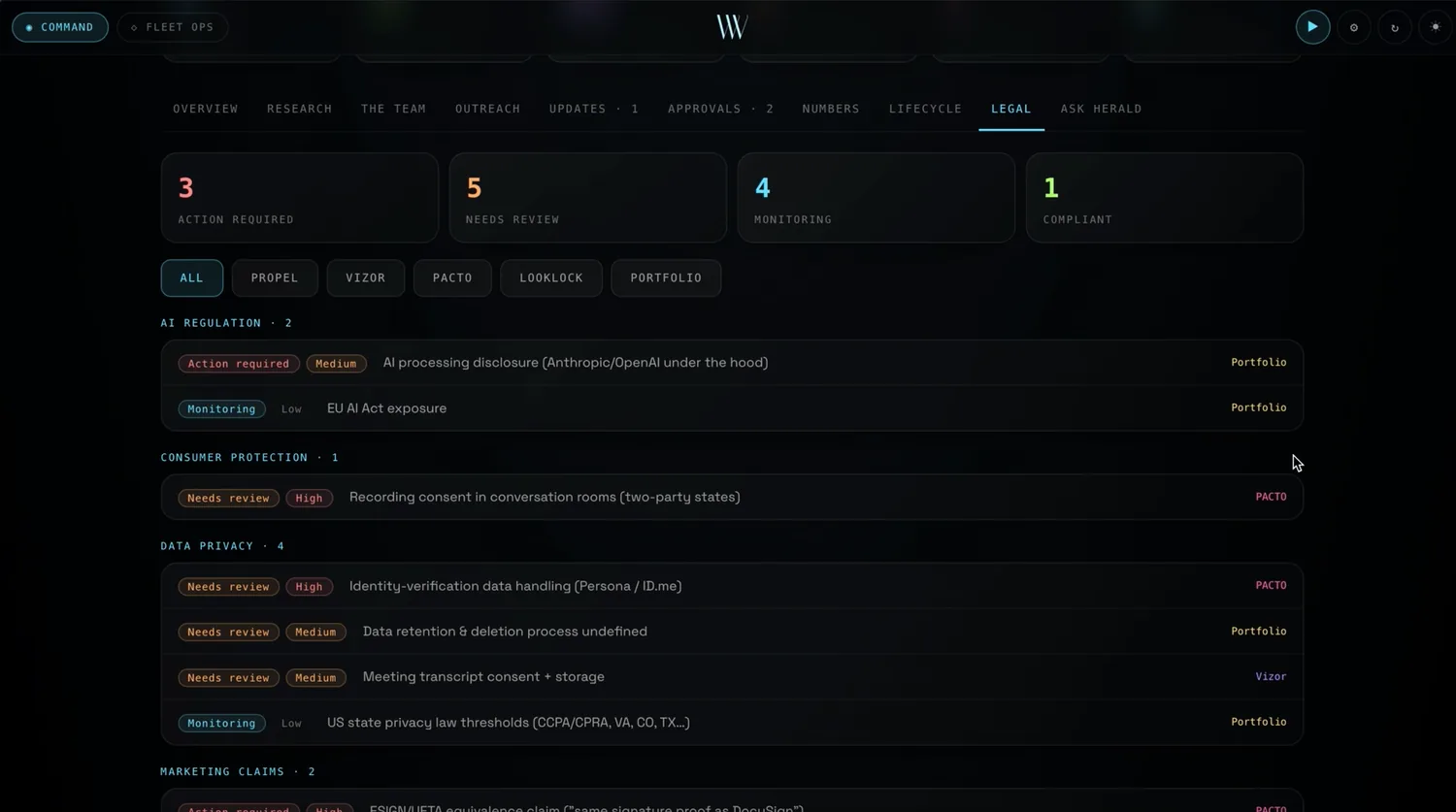
This is the closest thing in his record to the posting's fourth bullet: dashboards, reviews and inspection mechanisms that turn data into decisions, including the underlying queries, models and tooling. He did not write that tooling by hand, he directed it into existence and corrected it until it held, which is the skill the posting is actually describing when it says reach for code or AI before another meeting. It is also the reason he can claim daily hands-on AI use without hedging. What is on show here is a method, not a venture: how he decomposes a set of functions, decides which are worth automating, gives each one a schedule and a unit cost, and then builds the view that tells him whether it is working.
Six teams sent requests in six formats. Relay reads them before anyone commits.
Relay is the intake node Warren built at Dow Jones. It reads brief health before work is promised: which specs are missing, which background is absent, who has not been named. Then it maps the request against roadmap and capacity, so the conversation with a partner team starts from a complete picture instead of a partial brief. The graph below is its actual shape: six inlets, one triage step, one plan.
- read every request
- score brief health
- classify by workstream
- estimate and sequence
Owners, effort, sequence, and what is still missing. The same plan every requesting team sees.
Written over the API. Warren owns the team's implementation.
Relay maps the need at intake.
Six teams, six formats, one triage step that used to happen by hand every time. The output flows to Asana over the API, which Warren owns the implementation of.
Vizor allocates against it.
Vizor started as a side project. Transcription runs on the device, detects resourcing decisions live in the meeting, and stages them as one-click approval cards with the source sentence cited. Approved decisions flow into a weekly capacity grid and sync to Asana. It is in real production use today: he plans his own week on it, and so do a few agencies run by friends.
The posting asks for someone who identifies a high-friction workflow, prototypes the solution, and rolls it out to the team. Relay is that loop completed inside his employer. Vizor is the same loop run outside it: built on his own time, in real weekly use by him and by a few agencies run by friends. That is a smaller claim than an enterprise rollout and the page is not going to inflate it into one.
He reaches for code or AI before he reaches for a meeting.
Three built solo in roughly a year of nights and weekends. To be exact about how: he is not an engineer and he does not hand-write the code. He specifies the system, directs AI agents to build it, reviews what comes back, and sends it round again, with staff engineer friends at Meta and Google advising. The skill on show is knowing what to ask for and recognising when the answer is structurally wrong. He built them to pressure-test his own thinking end to end, not to found anything. Two of the three are in real production use today: Relay inside Dow Jones, adopted by a team that had other options, and Vizor with him and a handful of agencies run by friends. The third is on private staging, and this page says so rather than rounding up.
Reads brief health at intake for six requesting teams and writes the resourced plan to Asana over the API.
On-device transcription detects resourcing decisions live and stages them as approval cards with the source sentence cited, then syncs the approved decisions to Asana.
Surfaces the verbal commitments made on the calls teams already have, drafts the amendment for the host to review privately, and binds nothing until both parties sign. 94 development phases.
PACTO is the deepest of the three and the least glamorous underneath: ESIGN and UETA compliant signing, SHA-256 tamper-evident custody, identity verification and a reusable clause library. None of that is the interesting part and none of it gets built by accident. It is there because a tool people sign things inside has to hold up, which is the same reason a design system needs governance and not just components.
Ninety-four is a countable number because the work was sequenced into phases rather than generated in one pass. That is the difference between building software and prompting it. The point of showing these is not the products. It is the thinking: what to build, what to reuse, what to leave alone, and how to hold a sequence together for a year without a team to hold it with you.
Two years at Google. Two programs with opposite constraints.
The posting asks for problem framing and option analysis through to shipped rollout. Those are two different muscles and most program managers only have one. He ran both at the same employer at the same time.
Known spec. No room.
android.com, tv.google and wearos.google.com, under a long-running maintenance contract. Roadmap, creative, content, site deployment and localization, continuously re-prioritized against shifting business goals with four Google product marketing stakeholders and their web strategy director. The Android 12 launch ran through it on a public date.
Five workstreams reflow. The date does not.
No date. No spec. No known answer.
Separately, he planned and managed a year-long UI and UX research and design phase on the future of Google Search Ads, with a team of 4 to 6 designers on Huge's side, in collaboration with Google's Search UX Design Director and his team.
Nothing about that program was specified in advance. There was no launch to hit and no format to build. The work was to frame the problem, run the research, generate and narrow the options, and find out what search advertising should become. It ran for a year because that is how long the question took.
This is the ambiguity half of the posting's first bullet.
He was Huge's senior project manager in the Android pod, embedded at Google. He has also sat in the other chair, before and after: stewarding the APS design system into production with Infosys and 28 or more engineers at Vertic, then owning the Monaverse vendor relationship end to end at Everyrealm and bringing in Moving Brands for the NYU Langone audit on a later contract. Being the agency is how he learned what the client sounds like from the other end of the call.
One set of findings, out through every format a global enterprise uses.
The Better Health Study was one of GE Healthcare's largest marketing campaigns. Warren came in at the asset production phase. He did not run the research; he managed the client stakeholder relationship and built the production plan that carried a single set of findings all the way out without it drifting on the way.
High-volume delivery like this lives or dies on the pipeline: one source of truth for the findings and the brand system, review gates that caught drift before it multiplied across a hundred assets, and delivery sequencing that kept a distributed production team moving without compromising craft.
The posting asks for executive-level narratives that synthesize insight, frame decisions and build alignment. This is that job at global enterprise scale: not generating the insight, but making sure one version of it survived contact with every channel, every reviewer and every deadline. He also planned and oversaw the delivery of the supporting data analysis.
Acquisition, onboarding, upsell, and eight properties becoming one.
UX Program Manager for Brand. He partners with the commerce and acquisition product design teams on all brand touchpoints: customer acquisition and onboarding flows, upsell experiences, and event websites across WSJ.com, Barron's.com and MarketWatch.com. Day to day he operates across marketing, subscription strategy, commerce, product design and event marketing.
He owns the brand marketing team's Asana implementation for reporting, capacity and resource management. It is the review mechanism the team plans against.
Over the past five months, on fixed dates, alongside the migration.
He plans and oversees content design, UX and UI, and video production for all event properties.
A design system is a program, not a library. The two unmigrated properties are the next two milestones with owners and dates, not a rounding error, and this page would rather say six of eight than round to the nearest story. The 80 percent is his own measure of build time before and after, not an instrumented metric, and he would rather label it that way than have it fall apart in an interview. Cross-property design inconsistencies on the migrated properties are gone.
Every output fed the next one.
Oldest first, the way a graph reads. Click a node to load it into the inspector.
M.A. Digital Media Management, Hyper Island and Teesside University. B.S. Advertising Communications and Marketing Management, Sacred Heart University. Clients across the years include Microsoft, Google, SAP, Vodafone, Viacom, GE, Merck, NYU Langone, Novartis and Purina. Thirteen years. New York.
Four people have already written this down.
Everything else on this page is Warren describing Warren. These are the only sentences here written by someone else, so they are reproduced in full rather than trimmed to the flattering part.
“During my time at Google, Warren and I worked together on a year-long project, managing the design and development roadmap for updates to Android.com, tv.google, and various other web properties. Warren’s responsibilities included overseeing creative, content, site deployment, localization, and continuously adjusting priorities to align with business needs. He meticulously planned capacity and resources to meet targets across all workstreams while preventing team burnout. His dedication was crucial, and I can confidently say he is an outstanding professional with exceptional communication and problem-solving skills.”
HGHulya G.Director, Web Marketing Strategy, Google
“Warren and I worked together on a large-scale, year-long project for APS during our time at Vertic, where he took on a project management as well as a client management role. On this complex project with many moving parts, Warren proved to be a team player and a problem solver. He is incredibly personable and was able to develop a strong relationship with both the project team as well as the clients. His work added tremendous value to the success of the project and he would be a great asset to any team.”
SWStacey Wu EggimanSenior Interaction Designer, Google
“Warren is a phenomenal resource and human being to have within your organization and on your team. Not only is he a great project manager, with a drive to strictly do great work and do it as diligently as possible (financially, creatively and timing wise), but he is generally a go getter. He is always looking to help out however he can and do whatever is necessary to get the work done. He is very interested in UX and Design and has great input and expertise within that discipline and those types of projects. All of this is wrapped within an individual who is smart and very easy to get along with.”
GGGary GoldsmithDesign Operations, Meta
“Without a doubt, Warren is an exemplary project manager. I worked alongside him on a highly influential and complex, large-scale project, which required the utmost attention to detail. With his diligent planning, adaptability and expectation management (internal and external), Warren proved to be a true asset to the team. It is not an understatement to say his role was critical to the success of the project. Beyond that, Warren is an absolute joy to work with.”
NMNatasha MarkleyExecutive Director, Marketing and Partnerships, A+I, formerly W+K and Ogilvy
Titles are as each person gave them. Contact details on request.
Three things this graph cannot output.
-
He has never worked inside a creative-tools company.
Thirteen years of running the teams that consume design tools is not the same as building the product other designers live inside. He has been the customer, and once the client shipping onto someone else's live 3D creative platform, but never the maker.
-
He is not an engineer, and he has not worked inside a company's warehouse.
The posting asks for fluency with Looker, Mode or Hex. Warren does not hand-write production code. What he has learned to do is direct AI agents to build, and to drive them well enough that what comes out has real infrastructure underneath it: schemas he specified, queries he can read and correct, API integrations that hold, tamper-evident custody, and instrumentation with cost tracked per agent. He can define a data model, review what comes back against it, and tell when the answer is wrong. He has not sat inside a modern data stack at company scale, and a warehouse with a semantic layer and other people's models is a different job from instrumenting your own.
-
Inside a company he has run design and brand programs, not a whole business unit.
The operation in node 02 is his own and its headcount is one, which is a different problem from running the planning rhythm, the executive rituals and the All Hands of a real org. Company scope would be new surface, and he would rather say that here than discover it in month two.
The hard half of this job is judgment under ambiguity and the instinct to build the mechanism instead of booking the meeting. He has thirteen years of the first and a nineteen-agent operation proving the second. Looker is a week. Being trusted across six functions took a decade.
Why this role, and not the other ones he could have applied to.
Every node above this one is checkable. This one is not, so it is short.
Most postings ask for a program manager, or an operator, or someone technical, and treat the other two as a bonus. This one asks for all three in parallel and says so in its first paragraph. That is not a stretch he has to argue for. It is a description of his last twelve months, run in parallel: cross-functional programs for an employer by day, and three tools plus a nineteen-agent operating system specified, directed and instrumented on nights and weekends.
He has run design systems, design programs and production pipelines inside it for years, at Vertic, at Huge inside Google, at Everyrealm and at Dow Jones today. Node 10 admits he has never worked inside a creative-tools company. The other side of that sentence is thirteen years of being exactly the person these tools either serve or fail, at the volumes where the difference shows.
What Weave is trying to protect, craft surviving contact with generation, is the same thing he has spent thirteen years protecting at production scale: one source of truth, review gates that catch drift before it multiplies across a hundred assets, and a quality bar that holds when the volume goes up. He has done that with people. Doing it with models is the same job on a faster clock, and he has spent the last year proving to himself that he can.
One thing worth saying plainly, because this page invites the question. He has already run a business on his own. That is what the tools and the nineteen agents were: a year of nights and weekends finding out what one person can carry, and proving to himself that he can take a whole operating problem apart and put it back together without anyone to hand it to. He is not looking to do that again. He learned that he is better, and considerably happier, inside a team he admires than running the whole thing by himself.
So: joining this one would be a dream. He knows everybody writes that sentence, which is precisely why the other twelve nodes on this page are the ones you can check.
Export the output.
Figma Weave is hiring in New York. Warren is in New York.
Everything on this page is checkable, which is why the numbers are small and the statuses are the real ones. If any of it does not hold up, that is worth a conversation too.